
Identity Strain: When Success Makes Life Slowly Eroded
Why traditional burnout & identity crises explanations often miss what’s really going on for expats?
Expat exhaustion & sense of "emptiness" is often treated as burnout or “stress. adjustment”. Research points to a different driver: identity disruption combined with career misalignment.
You can be high-functioning - and still feel like something is quietly off in your own life.
If that resonates, this page names the pattern many expats experience - and outlines the path back to alignment.
This Is Not Anecdotal
Large-scale data confirms what many expats sense but struggle to name.
According to InterNations Expat Insider 2025, drawing on responses from 10,000+ expats worldwide, a significant share report:
persistent financial pressure, even in “successful” destinations
ongoing difficulty settling in and feeling at home
declining long-term satisfaction in countries that otherwise rank high for quality of life and career opportunity
Expat identity research suggests that when these pressures accumulate over time, the impact is not only a fragmented lifestyle, but a fragmented sense of self. What appears in surveys as dissatisfaction or adaptation difficulty reflects a deeper imbalance: identities stretched across roles, cultures, and expectations without sufficient coherence to sustain long-term alignment.
This ongoing disequilibrium is what we refer to as Identity Strain.
What Identity Strain Means for Midlife Expat Professionals
Identity Strain is a sustained state of internal disequilibrium that can emerge when high-functioning individuals maintain external success while internal coherence gradually erodes.
Many expatriates continue to perform well professionally, meet expectations, and remain outwardly stable - yet experience a growing sense that their life no longer feels internally aligned.
This condition is frequently described as burnout, stress, or a midlife crisis.
However, these explanations often fail to account for a key mechanism: prolonged identity incongruence under chronic adaptation.
Definition
Identity Strain refers to a persistent internal tension that arises when a person’s lived roles, environment, and long-term adaptations diverge from their core values, identity structure, and sense of self-continuity - without resulting in functional collapse.
When these elements lose coherence, the psychological system shifts from equilibrium to disequilibrium.
This sustained state is referred to as Identity Strain.
Unlike acute crises, Identity Strain develops gradually. Individuals often remain competent, productive, and socially integrated, while experiencing reduced inner coherence, emotional flattening, or difficulty articulating what feels “off” despite objective success.
Common Signs of Identity Strain
You feel split between several versions of yourself.
Your life looks right - but it doesn’t feel like yours.
You’re constantly adapting but still don’t feel fully “at home.”
You feel emotionally numb, drained, or directionless.
You feel like you’re “performing” a life instead of living yours.

WHAT IDENTITY STRAIN IS NOT
Identity Strain is frequently misclassified.
Because Identity Strain develops gradually and does not immediately impair functioning, it is often mislabeled as burnout, stress-related exhaustion, or an identity crisis.
These classifications are understandable - but incomplete.
They describe surface manifestations, not the underlying mechanism.
As a result, interventions that are effective for those conditions often fail to resolve what people experiencing Identity Strain report as the core issue: a persistent loss of internal coherence despite external stability.
To clarify the distinction, it is useful to compare Identity Strain with the two most common misclassifications.
Identity Crisis vs. Identity Strain - a structural distinction
An identity crisis is typically triggered by a major life disruption (relocation, loss, trauma, role collapse). It involves acute questioning of identity and often temporarily disrupts daily functioning.
Identity Strain, by contrast, emerges through prolonged adaptation. The individual continues to function, but internal coherence erodes as lived roles drift further from identity, values, and self-authorship.
This distinction matters because the same symptoms (confusion, dissatisfaction, questioning) arise from different mechanisms and therefore require different forms of resolution.
⬇️ The matrix below summarizes the structural differences.
Identity Crisis vs. Identity Strain — The Core Distinction
Identity Crisis is typically an acute questioning phase. Identity Strain is typically a chronic misalignment tension. Same arena (identity), different mechanism.
| Feature | 🧩 Identity Crisis | 🧭 Identity Strain |
|---|---|---|
| Trigger | Major life shift / relocation / shock | Accumulated mismatch over time |
| Nature | Acute questioning | Chronic tension |
| Experience | Loss, confusion, overwhelm | Incongruence, “something’s off” |
| Functionality | Often disrupts functioning | You can still operate well |
| Core gap | Who am I now? | Who am I vs. who I show up as? |
| Typical solution | Reflective identity work | Integration & alignment work |
Burnout vs. Identity Strain - capacity vs. coherence
Burnout is primarily a capacity failure.
It reflects depletion of energy, nervous system overload, and reduced resilience. Rest, recovery, and load reduction typically improve symptoms - at least temporarily.
Identity Strain is a coherence failure.
Energy may return with rest, but the underlying sense of misalignment remains. Individuals often report feeling “functional but off,” or able to perform without feeling internally oriented or engaged.
This explains why some people recover physically yet continue to feel disconnected from their work, direction, or sense of self.
⬇️ The matrix below contrasts these mechanisms directly.
Burnout vs. Identity Strain (I.S.) — The Core Distinction
Burnout is a capacity problem. Identity Strain is a coherence problem.
| Dimension |
Burnout
(capacity failure)
|
Identity Strain (I.S.)
(coherence failure)
|
|---|---|---|
| Primary failure | Capacity | Coherence |
| What breaks first | Energy & nervous system | Sense of self & inner authority |
| How it feels | Exhausted, cynical, depleted | Disconnected, conflicted, “off” |
| What rest does | Helps (at least temporarily) | Doesn’t resolve the issue |
| Core question | “How do I recover?” | “Why doesn’t this feel like me anymore?” |
| Real requirement | Recovery + load regulation | Role realignment + direction clarity |
Note: “Identity Strain” is not a diagnosis. It’s a non-clinical pattern describing prolonged misalignment between identity, roles, and lived reality.
Why Expats Are Disproportionately Affected
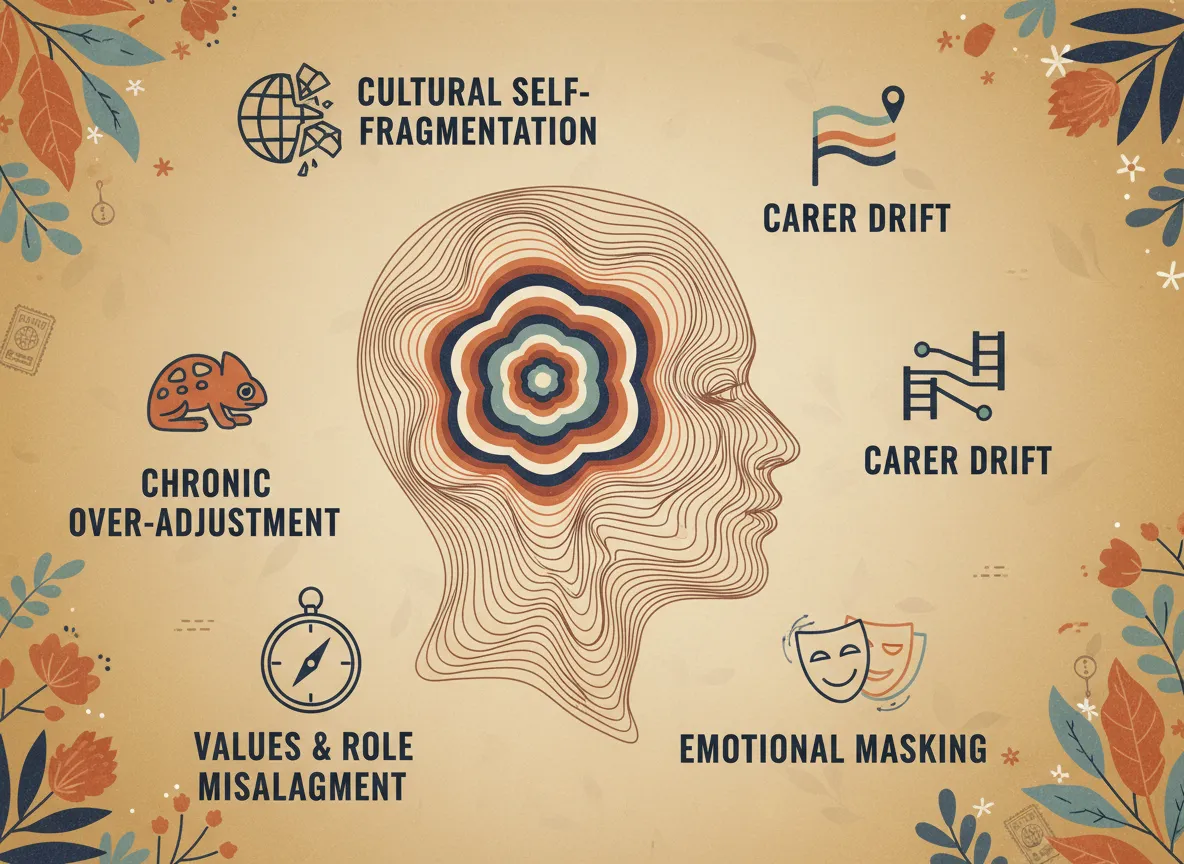
Identity Strain can occur in any context of prolonged misalignment.
However, expatriates - particularly high-functioning professionals - are exposed to a unique combination of structural and psychological conditions that make sustained disequilibrium more likely.
The issue is not relocation itself, but how adaptation unfolds over time.
1. Chronic adaptation without recalibration
Expat life requires continuous adaptation: new cultural norms, professional expectations, social rules, and implicit hierarchies. In the early stages, adaptation is functional and often energizing.
Over time, however, adaptation can become chronic.
When adaptation persists without periodic recalibration of identity, values, and agency, coherence gradually erodes. External functioning remains intact, but internal equilibrium weakens as the person increasingly operates from adjustment rather than authorship.
2. Role compression and over-identification
Many expatriates experience role compression: professional identity becomes the primary - or only - stable reference point in a foreign environment. Career success provides structure, legitimacy, and belonging.
As a result, other identity dimensions (personal values, relational roles, creative or reflective capacities) receive less reinforcement.
This over-identification with role can sustain performance in the short term while quietly narrowing identity bandwidth - making later misalignment harder to detect and articulate.
3. Identity outsourcing to systems and expectations
In unfamiliar environments, expatriates often rely on external systems for orientation: employers, visas, corporate structures, social scripts, and cultural expectations.
Over time, this can lead to identity outsourcing, where decisions, priorities, and self-definition are increasingly shaped by what “works” within the system rather than by internally authored direction.
This does not indicate passivity or weakness. It reflects pragmatic adaptation.
However, prolonged outsourcing reduces internal feedback loops that normally support equilibrium.
4. Delayed consequences of success-based adaptation
A defining feature of Identity Strain among expats is delay.
Because adaptation is often rewarded - financially, socially, and professionally - early signals of disequilibrium are easy to dismiss. The individual is functioning, progressing, and externally validated.
As a result, Identity Strain tends to surface not during difficulty, but after stability is achieved: when life appears “successful,” yet feels internally misaligned.
Summary
Expatriates are not more fragile.
They are more likely to sustain long periods of unexamined adaptation, which can shift the internal system from equilibrium to disequilibrium without triggering immediate failure.
This is why Identity Strain among expats is frequently subtle, persistent, and difficult to name - until it is finally recognized.
Observable Signals of Identity Strain
1. Internal signals
These indicators are primarily subjective and often difficult to articulate:
A persistent sense that life feels “off” despite objective stability
Emotional flattening or reduced engagement without clear sadness or anxiety
Difficulty locating a personal point of reference (“I’m not sure what I actually want anymore”)
Ongoing self-questioning without a triggering event
A sense of operating on autopilot rather than from intentional direction
Individuals frequently report that these experiences do not rise to the level of distress associated with crisis, yet do not resolve with rest or time off.
2. Behavioral patterns
At the behavioral level, Identity Strain often appears as continuity without coherence:
Sustained performance alongside reduced intrinsic motivation
Over-reliance on structure, routines, or external validation
Avoidance of reflective decisions that could disrupt stability
Increased tolerance of misalignment because “it works”
Periodic urges to disengage or make abrupt changes, followed by restraint
These patterns reflect adaptation, not failure.
3. Career and role markers
In professional contexts, Identity Strain often manifests as:
A growing disconnect between role and self-concept
Ambivalence toward advancement despite capability
Difficulty articulating next steps beyond “more of the same”
Reduced identification with organizational goals without disengagement
Questioning whether continued success is worth its personal cost
Importantly, these signals may coexist with strong performance reviews and external recognition.
4. What differentiates Identity Strain from burnout
A key distinguishing feature is persistence.
Rest, time off, or workload reduction may restore energy
The underlying sense of misalignment remains
Function returns faster than orientation
This pattern suggests a coherence issue rather than a capacity issue.
Summary
Identity Strain is not defined by collapse, distress, or dysfunction.
It is characterized by sustained disequilibrium within an otherwise functional life system.
Recognizing these signals early allows for re-orientation before strain accumulates further - particularly in contexts where adaptation has become the default mode of operation.
What Resolving It Looks Like
The Identity Strain Mechanism
Equilibrium
A state in which values, identity, roles, and lived reality operate in coherence.
Decisions are internally authored, roles feel representative rather than compensatory, and effort supports direction rather than compensates for misalignment.
Disequilibrium (Identity Strain)
A sustained state in which values and identity diverge from roles and life structure.
This divergence produces continuous internal tension and progressive exhaustion, even when external performance remains stable.
This mechanism differs from burnout.
Burnout reflects a breakdown in capacity.
Identity Strain reflects a breakdown in coherence.
Reducing load may restore capacity.
Only realignment restores orientation.
How Identity Strain Feel
Signs that point to the coherence problem:
# You feel split between versions of yourself
# Your life looks “on track” but feels hollow
# You adapt constantly without feeling at home
# Rest doesn’t restore meaning
You feel like you’re performing life instead of living it.
These are not personality flaws - they’re signals your identity structure is out of equilibrium.
What Restores Equilibrium
Because Identity Strain reflects a loss of internal coherence rather than depleted capacity, resolution does not come from rest alone. While rest may temporarily improve energy, it does not address the underlying disequilibrium.
Restoring equilibrium requires re-establishing coherence between identity, values, roles, and lived reality.
1. Reorientation precedes recovery
Individuals experiencing Identity Strain often attempt to recover through reduced workload, time off, or self-care interventions. These may alleviate fatigue but rarely restore a sense of direction.
What is required first is reorientation: clarifying what currently governs decisions, roles, and priorities, and where those forces diverge from internal values and identity.
Without reorientation, recovery remains temporary.
2. Coherence, not optimization
Identity Strain is not resolved by optimizing performance, productivity, or balance within an existing structure. In many cases, those optimizations prolong disequilibrium by making misalignment more tolerable.
Restoring equilibrium involves reintegrating identity with role, rather than refining role performance in isolation.
This often includes:
Reclaiming authorship over key life and career decisions
Re-evaluating roles that no longer represent the self
Reducing reliance on externally imposed identity structures
3. Alignment as a structural condition
In this context, alignment does not refer to mindset, attitude, or motivation.
It refers to a structural condition in which:
Roles express values rather than suppress them
Identity is reinforced, not fragmented, by daily activity
Success supports coherence instead of compensating for its absence
When this condition is restored, energy, engagement, and direction tend to stabilize as secondary effects - not primary goals.
Summary
Identity Strain resolves when internal equilibrium is restored.
This occurs not through coping better, but through realigning identity, roles, and lived reality into a coherent system.
Only after this coherence is re-established do conventional tools - rest, performance management, well-being practices - become reliably effective again.
GENIE as an Applied Framework for Identity Strain
The preceding sections describe Identity Strain as a state of sustained disequilibrium driven by prolonged identity – role misalignment, particularly in expatriate contexts. Addressing this condition requires more than symptom management or generic well-being interventions.
GENIE is one applied framework designed to respond to Identity Strain in expatriate professionals.
It is not a diagnostic tool or therapeutic intervention.
It functions as a structured alignment framework that integrates identity clarification with role and life realignment.
Purpose and scope
GENIE was developed to address a specific gap:
Burnout frameworks address capacity
Career coaching often addresses tactics
Identity work frequently remains abstract
GENIE focuses on restoring coherence across identity, roles, and lived reality, particularly where adaptation and success have masked misalignment.
The framework is educational and developmental in nature. It does not replace medical, psychological, or therapeutic care.
Core organizing principle
GENIE is built around a single organizing principle:
Sustainable performance and well-being depend on coherence, not endurance.
Rather than asking how individuals can cope better within misaligned structures, the framework examines why misalignment persists, and what structural changes are required to restore equilibrium.
Structural components (high-level)
At a high level, the GENIE framework integrates five domains commonly implicated in Identity Strain among expatriates:
Generational and cultural conditioning that shapes expectations and adaptation strategies
Identity structure and personality patterns that influence role adherence and self-regulation
Role and career alignment, including how professional identity is expressed or constrained
Purpose and value orientation, particularly where meaning has been deferred in favor of stability
Ongoing integration, recognizing that alignment is not static but iterative
These domains are addressed as an interconnected system rather than as isolated factors.
Boundary statement
GENIE does not diagnose, treat, or claim to resolve psychological conditions.
It provides a structured approach for individuals who remain high-functioning yet experience sustained internal disequilibrium related to identity and role misalignment.
Final positioning
Identity Strain describes the pattern.
GENIE represents one structured response to that pattern - developed specifically for expatriate professionals navigating prolonged adaptation and misalignment.
Further details on the framework, its structure, and its applications are provided separately.
And What Research Actually Shows?
Decades of peer-reviewed research tells a different story:
• Identity disruption at the core – not task overload
• Psychological conflict, not simply “too much work”
• Often persistent, not just a short adjustment phase
• Usually needs identity-level work, not only surface fixes
“Expatriation serves as a site for questioning the taken-for-granted foundation of cultural identity.”
– Hall, 1992 -
Identity Strain: The Real Driver of Expat Exhaustion
Identity Strain is the sustained psychological effort required to manage fragmented identities while navigating organizational inequity.
Unlike burnout – which focuses on workload and time management – Identity Strain targets the fundamental question
that keeps you up at night:
Who am I here?
For many expats, it becomes persistent and draining in ways “work-life balance” advice doesn’t touch.
This isn’t a mindset pep-talk problem. It’s a coherence problem that exhausts your emotional resources in ways no amount of “work-life balance” can fix.
Driver I: Identity Fragmentation ↓
Continuous psychological effort to reconcile conflicting selves ↓
Driver II: Career Misalignment ↓
Perceived organizational betrayal compounds the strain ↓
Result: Chronic Exhaustion (Identity Strain)
When these two forces collide, the result isn’t just tiredness. It’s a fundamental depletion of the psychological resources you need to function.
Driver I: Identity Fragmentation
The Challenge of the Plural Self
When you relocate internationally, you don’t just adapt. You fracture.
Research using symbolic interactionism and social identity theory reveals that expatriates operate with multiple, often contradictory identities simultaneously:
The Three Conflicting Identities:
Professional Identity
Manager. Leader. Expert.
The role you were
hired to perform.
Cultural Identity
Home country values vs. host country expectations. Neither fits completely anymore.
Social Identity
Foreigner. Outsider. Newcomer.
The label others
assign you.
The real exhaustion comes from switching between these conflicting roles – what researchers call “chronotopes.”
You present one version of yourself in the boardroom.
Another with local colleagues. Another with your expat peer group. Another with family back home.
Each transition requires cognitive effort. Each context demands a different performance.
The switching cost adds up… and up… and up.
You’re not just tired from work. You’re exhausted from constantly redefining who you are.
“The stability or change of these identities is intrinsically linked to the mode and degree of expatriate adjustment.”
– Symbolic Interactionism Research
Key Sources: Sussman (2000, 2001), Tajfel (1981), Takeuchi (2010)
Driver II: Career Misalignment
When Organizations Break the Promise
Maybe you've decided to live abroad for yourself. Or you accepted the assignment expecting career advancement.
Your organization needed operational coverage.
This mismatch isn’t just disappointing. It’s a fundamental breach of the psychological contract that compounds identity strain.
The Reality Gap:
What You Expected
Clear path to promotion
High-visibility opportunity
Career investment
Organizational support
What You Got
Operational necessity
Professional stagnation
Personal sacrifice without reward
Perceived betrayal
The Psychological Cost:
Research using Social Exchange Theory and Equity Theory confirms what you already feel: when the investment far exceeds the return, the result is chronic organizational anxiety.
You invested extensive effort. Family sacrifice. The psychological toll of identity disruption.
The organization got what it needed. You got… uncertainty about what comes next.
This unjust exchange ratio doesn’t just undermine job satisfaction. It continuously erodes your commitment, your trust, and your emotional reserves.
The Compounding Effect:
Career misalignment doesn’t exist in isolation. It compounds the identity fragmentation you’re already managing.
Your professional identity – a core pillar of adult self-concept – is wounded by the perception of career failure. This injury stacks on top of the cultural fragmentation, creating a debilitating identity failure across both professional and cultural domains.
You can’t justify the move’s high personal cost to yourself. You can’t explain it to your family. The cognitive dissonance becomes unbearable.
Here’s What That Means
These aren’t signs of weakness. They’re not evidence of poor adjustment or lack of resilience.
They’re the predictable consequences of Identity Strain – a documented psychological condition that requires targeted intervention, not generic burnout advice.
The exhaustion you feel isn’t because you’re working too many hours. It’s because you’re managing multiple, conflicting identities while navigating organizational inequity that undermines your professional self-concept.
No amount of meditation apps, time management workshops, or “self-care Sundays” will fix a problem rooted in identity fragmentation and career misalignment.
You need a solution that addresses the root cause.
Built on Rigorous Academic Research
The Identity Strain Model synthesizes decades of peer-reviewed research on expatriate psychology, cultural identity, and organizational behavior.
Sussman’s Cultural Identity Model (2000–2002)
Foundational research on cultural identity transformation during international assignments. Marked a “noteworthy turning point” in the field and remains the leading reference for expatriate social identities in international business literature.
Szkudlarek’s Identity Shift Research (2008)
First to explicitly document “profound identity shifts” in global careers using the Cultural Identity Model. Demonstrated that identity changes during expatriation are deep-seated and permanent, not superficial adjustments.
Wittig-Berman & Beutel’s Career Research (2009)
Identified career misalignment as a critical driver of expatriate distress through Social Exchange Theory. Confirmed that perceived organizational inequity continuously undermines commitment and fuels emotional exhaustion.
Takeuchi’s Person-Situation Model (2010)
Demonstrated how cultural context intensifies identity management effort. High cultural distance, cultural tightness, and gender inequality compound the psychological burden of maintaining identity stability.
Recent qualitative research on midlife expatriates shows a consistent psychological pattern.
Around ages 40–55, many high-achieving expats reach a turning point where their sense of identity,
belonging, and success becomes less stable.
This body of migration research demonstrates systematic identity destabilization under structural transition conditions. Identity Strain integrates and extends these findings by isolating chronic post-adjustment misalignment among high-functioning professionals.
Why This Matters:
This isn’t pop psychology or coaching buzzwords. The Identity Strain Model is grounded in decades of academic research from leading scholars in organizational psychology, cultural identity, and expatriate studies.
The evidence is clear.
The mechanisms are documented.
The solution requires addressing the root cause – not just treating symptoms.
Identity Strain FAQ
Question 1: What exactly is Identity Strain?
Identity Strain is a form of internal misalignment where your lived identity and your authentic self drift apart. It’s common among high-performing expats who’ve adapted repeatedly across environments.
Question 2: How is Identity Strain different from burnout?
Burnout is primarily emotional and physical exhaustion.
Identity Strain is a misalignment problem - even well-rested people still feel disconnected, directionless, or “not themselves.”
Question 3: Why do expats experience Identity Strain more intensely?
Because expats often build multiple “selves” to fit into foreign environments — corporate, cultural, social — and these layers eventually conflict.
Question 4: How do you resolve Identity Strain?
Through structured realignment: understanding root patterns, releasing outdated identities, recalibrating values, and realigning your career/life direction with your authentic identity.
AS SEEN ON




Hear From My Clients
So the lightness is unspeakable…Gratitude is boundless and cannot be valued by any wealth.… The path taken together brought priceless experience and ignited hope… opened the soul and showed the way… The way to a new life, a life that I can create myself with the help of the Universe

Sandra W.
Health Coach
I returned to my inner axis in the fastest and the most effective way. I’ve got strong and indisputable realizations about my own responsibility and reached a state of inner peace and raised my self-esteem. Now I know my life’s mission and have the purpose of life..

Mark H.
Leadership Coach

The Extra Mile: How to unlock your highest potential
Unlock the secret to better digestive health with 'Gut Feeling.' Discover how to nourish your gut and improve your overall well-being. ... more
mind and body
08 April 2024 • 7 min read

The Extra Mile: How to unlock your highest potential
Unlock the secret to better digestive health with 'Gut Feeling.' Discover how to nourish your gut and improve your overall well-being. ... more
mind and body
08 April 2024 • 7 min read
From Research to Transformation
Understanding Identity Strain is the first step. Recognition helps. Action is what changes your day-to-day experience.
The GENIE Life Power Accelerator provides the structured framework to move from exhaustion to alignment – integrating inner rewiring with outer redesign in a 12-week transformation process.
This isn’t another wellness program. It’s a structured coaching process for expats navigating identity strain and is designed specifically for the unique psychological challenges of high-level professional expats experiencing Identity Strain.
You’ll start with the Career & Life Fit Check.