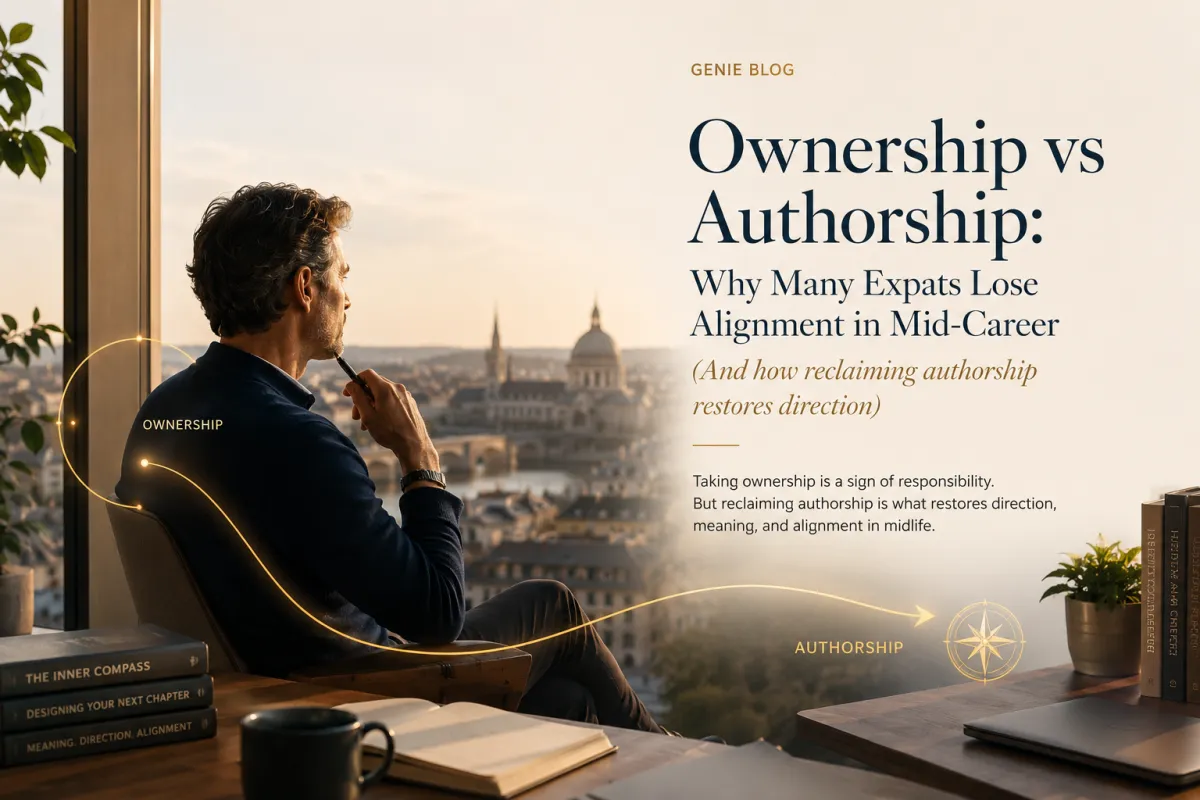
Ownership vs Authorship: Why Many Expats Lose Alignment in Mid-Career
And how reclaiming authorship restores direction
Many professionals working abroad follow a simple leadership principle:
Take ownership.
Own the project.
Own the results.
Own the responsibility.
In corporate culture, ownership is treated as a sign of maturity, reliability, and leadership. Leaders value people who do not blame circumstances, who take responsibility for outcomes, and who can be trusted when things become complex.
For many expats, this becomes almost second nature.
They take ownership of the role.
They take ownership of the relocation.
They take ownership of the family adjustment, the cultural learning, the career pressure, the financial stability, and the invisible emotional labour that comes with building a life in another country.
From the outside, they often look capable and successful.
But after several years abroad, something quieter can begin to happen.
They are still responsible.
They are still performing.
They are still carrying what needs to be carried.
Yet internally, many begin to feel a subtle form of career and life misalignment.
Not because they lack discipline or ambition.
Not because they are ungrateful for the life they have built.
But because something deeper has faded:
The sense that they are still the author of the life they are living.
Why career misalignment happens to many expats
Living abroad requires constant adaptation.
New cultural expectations.
Different workplace dynamics.
Changing social environments.
A new language, or at least a new emotional rhythm inside the language.
Different rules about visibility, confidence, hierarchy, communication, belonging, and success.
These adjustments are part of the expat experience. Often, they create real growth. They make people more flexible, more resilient, more aware, and more capable.
But long-term adaptation can also have a hidden cost.
You become very good at functioning inside the system.
So good, in fact, that you may slowly lose clarity about whether the system still reflects who you are.
Many expat career decisions are shaped by practical realities.
A role appears at the right time.
A relocation opens a door.
A partner’s career influences the next step.
Financial security becomes the priority.
A visa, school choice, housing situation, or family need shapes what seems possible.
Each decision may make complete sense in the moment.
But over time, the path can become shaped more by momentum than by conscious direction.
And this is where many high-achieving mid-career expats find themselves:
Externally successful.
Internally uncertain.
Not because something is obviously wrong.
But because the sense of authorship has quietly weakened.
Ownership vs authorship: the distinction that changes everything
Ownership and authorship are often confused.
But psychologically, they are very different positions.
Ownership means taking responsibility for your actions, performance, and outcomes.
It asks: “Am I responsible for what happens?”
Authorship asks a different question: “Am I consciously shaping the direction of my life?”
Ownership keeps the current system functioning.
Authorship asks whether the system still belongs to you.
Ownership says: “I will handle this.”
Authorship asks: “Is this still mine to carry?”
That distinction matters.
Many expats experiencing midlife career uncertainty are not lacking ownership.
They have often spent years demonstrating responsibility, resilience, adaptability, and loyalty.
They know how to deliver or how to cope.
They know how to keep going.
But what they may be missing is not more responsibility.
It is authorship.
The ability to step back and ask:
“Is the life I am maintaining still aligned with the person I am becoming?”
The hidden cost of long-term adaptation abroad
When professionals move countries, they naturally adapt.
They adjust their behavior.
They adapt their communication style.
They learn what is rewarded and what is misunderstood.
They become more careful in some places, more visible in others, more independent, more controlled, more flexible, or more silent.
This is normal.
It is part of surviving and succeeding in a new environment.
But adaptation repeated over many years can begin to reshape identity.
The professional self that performs well in the system becomes stronger than the inner self that originally chose the path.
At first, this may not feel like a problem.
In fact, it often feels like growth.
You become capable.
You become trusted.
You become the person who can manage uncertainty.
But eventually, some people begin to notice a quiet split.
The role still works.
The life still functions.
The achievements still look good.
But something inside no longer fully agrees.
This is when questions begin to appear:
Why does my career success feel strangely disconnected from who I am?
Why do my professional achievements no longer feel personally meaningful?
Why do I feel stuck when nothing is clearly wrong?
Why am I so tired of a life I worked hard to create?
These questions are not signs of failure.
They are often signs that authorship is asking to return.
Reclaiming authorship does not mean burning everything down
Many people resist this kind of reflection because they fear where it might lead.
They imagine that if they question their current path, they will have to make a dramatic change.
Quit the job.
Leave the country.
End the relationship.
Start again from zero.
But reclaiming authorship does not begin with destruction.
It begins with honesty.
It begins by stepping back from the momentum of adaptation and asking what has been chosen consciously, and what has simply accumulated over time.
It may include questions like:
Is the role I occupy still aligned with the person I am becoming?
Which responsibilities are truly mine, and which have I absorbed because I am capable?
Which parts of my life still feel alive?
Which parts feel maintained rather than chosen?
What would I design differently if I were creating the next chapter intentionally?
These questions do not force an immediate decision. They restore inner authority.
And that is where alignment begins.
Alignment begins when responsibility meets authorship
Many professionals search for alignment by changing external circumstances.
A new role.
A different company.
A relocation.
A new qualification.
A cleaner routine.
Sometimes those changes help.
But alignment rarely comes from external adjustment alone.
It comes from reconnecting two capacities that often become separated in expat life.
Ownership ensures you show up responsibly.
Authorship ensures the life you show up to is truly yours.
When these two come back into relationship, something important shifts.
Work begins to regain meaning.
Decisions become clearer.
Boundaries become less confusing.
Energy returns, not as hype, but as inner coherence.
You no longer carry responsibility only because you can.
You begin choosing what is truly yours to carry.
That is a different kind of leadership.
Not louder. Not more impressive from the outside.
But more honest. More rooted. More sustainable.
A question worth asking
For professionals living abroad, career success often comes from the ability to adapt.
But at a certain stage of life, adaptation is no longer enough.
Another capacity becomes just as important:
The ability to pause and ask whether the life you are maintaining still reflects the person you are becoming.
So the question is not only:
Am I taking ownership of my responsibilities?
The deeper question is:
Am I still authoring the life I am living?
That question alone can begin restoring alignment.
Because sometimes the next chapter does not begin with doing more.
It begins with remembering that the pen is still in your hand.
